The Story:
New leader has local ties
The election of the Rt. Rev. Katharine Jefferts Schori as presiding bishop of
the Anglican Church in America came as no shock to her former "boss" here
in Corvallis.
"I'm not surprised. She's very qualified and quite brilliant," said the
Rev. Bill McCarthy, the recently retired rector of the Episcopal Church
of the Good Samaritan.
For more of this story, click on or type the URL below:
http://www.gazettetimes.com/articles/2006/06/19/news/
community/monloc02.txt
A special thanks to reader Pogo who provided the source information
on this story. Local girl makes good...well, we KNEW that.
Saturday, July 01, 2006


+Katharine Jefferts Schori interviewed by major Oregon newspaper
The following is a portion of an interview in today's "Oregonian":
How would you describe the process of becoming nominated for the office of presiding bishop?
It was a struggle. Several people over the years suggested it to me. About three years ago, the bishops had to elect someone to serve on the nominating committee. I thought I would be interested in doing that. And one of the bishops said, "You can't. We can't elect someone who might be eligible as a candidate." I thought that was pretty ridiculous, and I told him so. I had only been a bishop for two years. I was a woman. I was pretty young. I was serving one of the smaller dioceses in the church.
Once the voting began, did you think about withdrawing because of the tension your election might create?
No. If you say yes to being nominated, you are saying yes to the movement of the Spirit.
The response to your election has been described as "wan" on the archbishop's part and almost hostile from other quarters. One pastor said you would not be welcome in his diocese. What do you make of these reactions?
They are quite predictable. There are three dioceses in this country that don't ordain women. No one expects these bishops to respond any differently. I can understand that my presence among the rest of the primates is going to challenge some of them, and that it might make the archbishop of Canterbury's job harder.
Will you be the only woman sitting at that global table of primates?
Yes. But I've spent most of my adult life as a woman in occupations that are primarily male-dominated. It's where I've always functioned.
In your homily at the closing session of the General Convention, you said, "We children can continue to squabble over the inheritance or claim our name and heritage as God's beloved." Did you have your critics in mind?
That wasn't in my consciousness as I wrote it. I was trying to address the challenges of the convention and what people would face when they got home.
And what were those challenges?
We had just finished wrestling with our responses to the Windsor Report. It had been a challenging road. We did the best we could have done at this point in our history. We have to all be willing to stretch, especially with people who are the most challenging.
How far you can stretch?
We're all human beings. We all have our limits. I don't know what mine are.
Is a schism or break in the Anglican Communion the worst thing that could happen during your nine-year tenure?
I think that the worst thing that could happen would be for the church to forget why it's here, to forget our mission. That mission looks different in different places. We can work at healing the world around us, at transforming the communities in which we live -- or we can spend our time arguing.
As presiding bishop, will you need to set aside your personal convictions on gay rights for the greater good of the church?
That is a piece of who I am. I am not going to set that aside. It is a piece of my vocation.
You can read the rest here:
http://www.oregonlive.com/printer/printer.ssf?/news/
115172253994680.xml&coll=7&thispage=3
I thank the Rev. Susan Russell and the Integrity USA news network for the source of this information.
How would you describe the process of becoming nominated for the office of presiding bishop?
It was a struggle. Several people over the years suggested it to me. About three years ago, the bishops had to elect someone to serve on the nominating committee. I thought I would be interested in doing that. And one of the bishops said, "You can't. We can't elect someone who might be eligible as a candidate." I thought that was pretty ridiculous, and I told him so. I had only been a bishop for two years. I was a woman. I was pretty young. I was serving one of the smaller dioceses in the church.
Once the voting began, did you think about withdrawing because of the tension your election might create?
No. If you say yes to being nominated, you are saying yes to the movement of the Spirit.
The response to your election has been described as "wan" on the archbishop's part and almost hostile from other quarters. One pastor said you would not be welcome in his diocese. What do you make of these reactions?
They are quite predictable. There are three dioceses in this country that don't ordain women. No one expects these bishops to respond any differently. I can understand that my presence among the rest of the primates is going to challenge some of them, and that it might make the archbishop of Canterbury's job harder.
Will you be the only woman sitting at that global table of primates?
Yes. But I've spent most of my adult life as a woman in occupations that are primarily male-dominated. It's where I've always functioned.
In your homily at the closing session of the General Convention, you said, "We children can continue to squabble over the inheritance or claim our name and heritage as God's beloved." Did you have your critics in mind?
That wasn't in my consciousness as I wrote it. I was trying to address the challenges of the convention and what people would face when they got home.
And what were those challenges?
We had just finished wrestling with our responses to the Windsor Report. It had been a challenging road. We did the best we could have done at this point in our history. We have to all be willing to stretch, especially with people who are the most challenging.
How far you can stretch?
We're all human beings. We all have our limits. I don't know what mine are.
Is a schism or break in the Anglican Communion the worst thing that could happen during your nine-year tenure?
I think that the worst thing that could happen would be for the church to forget why it's here, to forget our mission. That mission looks different in different places. We can work at healing the world around us, at transforming the communities in which we live -- or we can spend our time arguing.
As presiding bishop, will you need to set aside your personal convictions on gay rights for the greater good of the church?
That is a piece of who I am. I am not going to set that aside. It is a piece of my vocation.
You can read the rest here:
http://www.oregonlive.com/printer/printer.ssf?/news/
115172253994680.xml&coll=7&thispage=3
I thank the Rev. Susan Russell and the Integrity USA news network for the source of this information.
NPR Station WAMU provides link to hear +Katharine's interview
The Rt Rev Katharine Jefferts Schori sat down with NPR Washington DC's Diane Rehm for a 50 minute interview on June 29th, 2006. To hear the entire interview please go to: http://www.wamu.org/programs/dr/06/06/29.php#11030 I personally think we will find it not only inspiring but most certainly edifying and encouraging.
So if you haven't yet heard it, here it is!
ALSO...
The online version of the Episcopal Life newspaper also has an in depth interview with our soon to be ++Katharine. You can go there by clicking here: http://www.episcopal-life.org/26724_73917_ENG_HTM.htm
Just all kinds of newsy news, huh?
Peace,
Catherine+
So if you haven't yet heard it, here it is!
ALSO...
The online version of the Episcopal Life newspaper also has an in depth interview with our soon to be ++Katharine. You can go there by clicking here: http://www.episcopal-life.org/26724_73917_ENG_HTM.htm
Just all kinds of newsy news, huh?
Peace,
Catherine+
Friday, June 30, 2006
"She Will Not Be Alone" by Bishop Barbara C. Harris
Friday, June 30, 2006
___________________________________
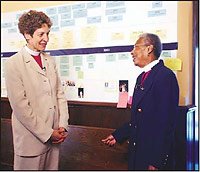 The election of the Rt. Rev. Katharine Jefferts Schori as 26th Presiding Bishop of the Episcopal Church is momentous for several reasons -- not the least of which is that many General Convention deputies, visitors and bishops themselves did not believe the House of Bishops had the moral courage to choose the obviously superior nominee. The conventional wisdom was that a "compromise" person, palatable to both sides of the church and the rest of the Anglican Communion, would be chosen in the hope that we might "get on with it" -- whatever "it" is.
It has been reported that a few retired conservative bishops (as many as nine) voted for her to demonstrate the split in the American church, but that can be documented only by those who would have concocted such a self-defeating scheme.
Read the rest of this article in The Witness here: http://www.thewitness.org/article.php?id=1102
___________________________________
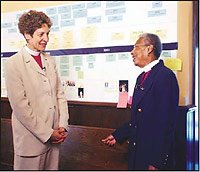 The election of the Rt. Rev. Katharine Jefferts Schori as 26th Presiding Bishop of the Episcopal Church is momentous for several reasons -- not the least of which is that many General Convention deputies, visitors and bishops themselves did not believe the House of Bishops had the moral courage to choose the obviously superior nominee. The conventional wisdom was that a "compromise" person, palatable to both sides of the church and the rest of the Anglican Communion, would be chosen in the hope that we might "get on with it" -- whatever "it" is.
It has been reported that a few retired conservative bishops (as many as nine) voted for her to demonstrate the split in the American church, but that can be documented only by those who would have concocted such a self-defeating scheme.
Read the rest of this article in The Witness here: http://www.thewitness.org/article.php?id=1102
"I Stand at the Door": An Apologia for my Life by Sam Shoemaker (from the Oxford Group)
I stand by the door.
I neither go too far in, nor stay too far out.
The door is the most important door in the world -
It is the door through which men walk when they find God.
There is no use my going way inside and staying there,
When so many are still outside and they, as much as I,
Crave to know where the door is.
And all that so many ever find
Is only the wall where the door ought to be.
They creep along the wall like blind men,
With outstretched, groping hands,
Feeling for a door, knowing there must be a door,
Yet they never find it.
So I stand by the door.
The most tremendous thing in the world
Is for men to find that door - the door to God.
The most important thing that any man can do
Is to take hold of one of those blind, groping hands
And put it on the latch - the latch that only clicks
And opens to the man's own touch.
Men die outside the door, as starving beggars die
On cold nights in cruel cities in the dead of winter.
Die for want of what is within their grasp.
They live on the other side of it - live because they have not found it.
Nothing else matters compared to helping them find it,
Nothing else matters compared to helping them find it,
And open it, and walk in, and find Him.
So I stand by the door.
Go in great saints; go all the way in -
Go way down into the cavernous cellars,
And way up into the spacious attics.
It is a vast, roomy house, this house where God is.
Go into the deepest of hidden casements,
Of withdrawal, of silence, of sainthood.Some must inhabit those inner rooms
And know the depths and heights of God,
And call outside to the rest of us how wonderful it is.
Sometimes I take a deeper look in.
Sometimes venture in a little farther,
But my place seems closer to the opening.
So I stand by the door.
There is another reason why I stand there.
Some people get part way in and become afraid
Lest God and the zeal of His house devour them;
For God is so very great and asks all of us.
And these people feel a cosmic claustrophobia
And want to get out. 'Let me out!' they cry.
And the people way inside only terrify them more.
Somebody must be by the door to tell them that they are spoiled.
For the old life, they have seen too much:
One taste of God and nothing but God will do any more.
Somebody must be watching for the frightened
Who seek to sneak out just where they came in,
To tell them how much better it is inside.
The people too far in do not see how near these are
To leaving - preoccupied with the wonder of it all.
Somebody must watch for those who have entered the door
But would like to run away.
So for them too,I stand by the door.
I admire the people who go way in.
But I wish they would not forget how it was
Before they got in. Then they would be able to help
The people who have not yet even found the door.
Or the people who want to run away again from God.
You can go in too deeply and stay in too long
And forget the people outside the door.
As for me, I shall take my old accustomed place,
Near enough to God to hear Him and know He is there,
But not so far from men as not to hear them,
And remember they are there too.
Where? Outside the door -Thousands of them.
Millions of them.But - more important for me -
One of them, two of them, ten of them.
Whose hands I am intended to put on the latch.
So I shall stand by the door and wait
For those who seek it.
'I had rather be a door-keeper
'I had rather be a door-keeper
So I stand by the door.
This poem was sent to me by my brother in Christ known on the 'Net as EastBayWill. I thank him for sharing it with me, and now you.
Retrograde General Convention: Episcopal Church Fails To Challenge Homophobia By Embracing Windsor Report
The following is a Media Release of 30 June 2006 by way of Integrity USA regarding the reaction of the UK's LGCM [Lesbian Gay Christian Movement]:
Following the decisions of The Episcopal Church in the USA to conform to the terms of the Windsor Report, The Revd Richard Kirker, Chief Executive of the Lesbian and Gay Christian Movement [LGCM] has issued a statement (30 June 2006) saying:
“I deeply regret the retrograde resolutions of the recent General Convention and deplore their abandonment of a Holy principle to pander to the evil that persists in many Christian hearts against us.”
The General Convention decisions will make it impossible for a partnered lesbian or gay priest to be consecrated a bishop and Mr Kirker says that the American Episcopalians were “coerced” into changing their stance.
Mr Kirker said he believed the Windsor Report commissioned by the Archbishop of Canterbury following the consecration of Gene Robinson as a bishop was “profoundly flawed” and that it “contains the seeds of destruction for our Communion”
“Our Church does have a sickness, the sickness of institutional homophobia, but the illness has been misdiagnosed and the treatment will mortify that what is good and leave the disease untouched.” He said.
Referring to the paper The Challenge and Hope of Being an Anglican Today: A Reflection for the Bishops, Clergy and Faithful of the Anglican Communion published by the Archbishop of Canterbury this week which sees the Anglican Communion dividing into full and associate members, Mr Kirker says: ““I have no wish to see a divided Communion, this will not serve the mission of the Church as we proclaim the good news of Jesus Christ, and it will increase the sense of rivalries with ever more contentious and bitter arguments over jurisdictions.”
But Mr Kirker believes that the plan laid out by the Archbishop of Canterbury will never be completed as other forces in the Anglican Church take control, ““We will indeed see a very different Church develop from our current divisions, but a large part of it will not be centered on Canterbury and the fall out to win unity and power will leave to those who remain with Canterbury a legacy they would not want.” He said.
Mr Kirker looked back at the joy and celebration that greeted the consecration of Gene Robinson and concluded: “Lesbian and gay Anglicans are still celebrating the faith, they still celebrate their sexuality and loving partnership, they look again for another day when they are celebrated by their own Church.
Following the decisions of The Episcopal Church in the USA to conform to the terms of the Windsor Report, The Revd Richard Kirker, Chief Executive of the Lesbian and Gay Christian Movement [LGCM] has issued a statement (30 June 2006) saying:
“I deeply regret the retrograde resolutions of the recent General Convention and deplore their abandonment of a Holy principle to pander to the evil that persists in many Christian hearts against us.”
The General Convention decisions will make it impossible for a partnered lesbian or gay priest to be consecrated a bishop and Mr Kirker says that the American Episcopalians were “coerced” into changing their stance.
Mr Kirker said he believed the Windsor Report commissioned by the Archbishop of Canterbury following the consecration of Gene Robinson as a bishop was “profoundly flawed” and that it “contains the seeds of destruction for our Communion”
“Our Church does have a sickness, the sickness of institutional homophobia, but the illness has been misdiagnosed and the treatment will mortify that what is good and leave the disease untouched.” He said.
Referring to the paper The Challenge and Hope of Being an Anglican Today: A Reflection for the Bishops, Clergy and Faithful of the Anglican Communion
But Mr Kirker believes that the plan laid out by the Archbishop of Canterbury will never be completed as other forces in the Anglican Church take control, ““We will indeed see a very different Church develop from our current divisions, but a large part of it will not be centered on Canterbury and the fall out to win unity and power will leave to those who remain with Canterbury a legacy they would not want.” He said.
Mr Kirker looked back at the joy and celebration that greeted the consecration of Gene Robinson and concluded: “Lesbian and gay Anglicans are still celebrating the faith, they still celebrate their sexuality and loving partnership, they look again for another day when they are celebrated by their own Church.
Thursday, June 29, 2006
Reflections of Thursday Healing and Eucharist
Simple gathering
centered in the week,
hearts given over to You.
Kneeling for the blessing
given so freely,
kairos time is upon us.

The last to be touched
hands resting upon my head,
silence incarnate.
Words spoken
I hear Jesus,
embodied in this priest.
Homily shared
lesson brought to light,
enlightenment received.
Peace given,
peace returned,
quiet recedes.

Gathered now as
chicks to our hen,
we wait.
With the bread of Body
we are fed,
each feeding the other,
With wine our thirst
is quenched anew,
blessed by holiness.

In quiet awe
marveling at the Presence
of Christ, our Mother with us;
And in us,
encompassing us
as if for the very first time.
For such a time as this,
how my spirit soars
knowing joy unspoken.
Nothing heals us
like You do...
centered in the week,
hearts given over to You.
Kneeling for the blessing
given so freely,
kairos time is upon us.

The last to be touched
hands resting upon my head,
silence incarnate.
Words spoken
I hear Jesus,
embodied in this priest.
Homily shared
lesson brought to light,
enlightenment received.
Peace given,
peace returned,
quiet recedes.

Gathered now as
chicks to our hen,
we wait.
With the bread of Body
we are fed,
each feeding the other,
With wine our thirst
is quenched anew,
blessed by holiness.
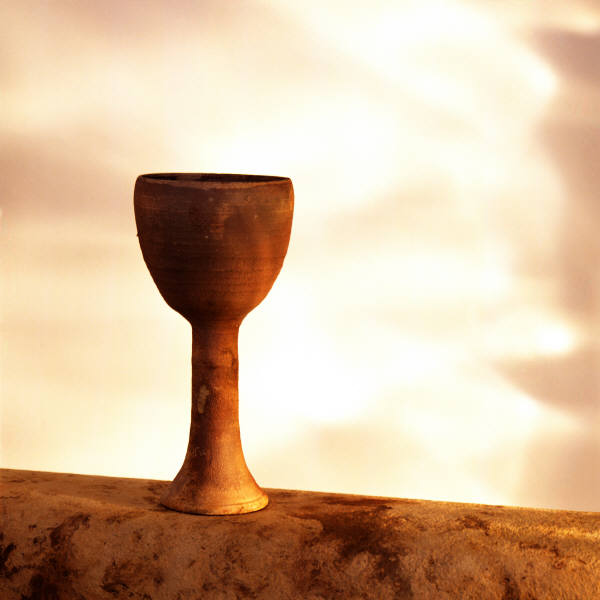
In quiet awe
marveling at the Presence
of Christ, our Mother with us;
And in us,
encompassing us
as if for the very first time.
For such a time as this,
how my spirit soars
knowing joy unspoken.
Nothing heals us
like You do...
Subscribe to:
Posts (Atom)