Episcopal News Service
Monday, July 17, 2006
Kenya's Dr. Esther Mombo lectures at women's ordination conference in Manchester
By Matthew Davies
[ENS, Manchester, England] The impact of Christian women on African society was the focus of Dr. Esther Mombo's closing lecture, titled "We see them and hear them...but has it made a difference?" at a conference on women's ordination hosted by the University of Manchester's Lincoln Theological Institute July 12-14.
Mombo, dean of St. Paul's United Theological Seminary in Limuru, Kenya, acknowledged that the present church leadership is extremely vocal on issues of sexuality, but insisted that for women in Africa that is not a priority.
"The priority is for life," she said. "We are not having the discussions that we see in public, such as human sexuality, but discussions of life and death issues."
One of the world's largest continents, Africa accounts for about 14 percent of the total population and boasts vast ethnic and cultural diversity, but some countries are roiled with conflict, and HIV/AIDS, malaria and other diseases continue to pose life-size challenges.
Recent statistics suggest that 42 million people in the world are living HIV/AIDS, with 25.8 million of those cases in Africa. "Although Africa has
14 percent of the world's population, it has 62 percent of the world's HIV/AIDS cases," Mombo said.
For women in Africa, the problem is with heterosexuality not homosexuality, she said. "It is the heterosexuals who will rape small children in the hope that [such a myth] will rid them of HIV/AIDS."
Women's ordination in Africa plays a vital role in helping to overcome gender inequality, poverty, violence and HIV/AIDS, Mombo explained, as "it provides an important place for women to contribute to the wellbeing of people in society."
African Christianity, she said, has created its own unique flavor of religion and has assumed a more charismatic character. It tends to be described as conservative, especially in light of its proactive evangelistic mission, but has long been presented as vital and growing. The 12 Anglican provinces in Africa account for almost two thirds of the world's 77 million Anglicans.
"When you look at the ordinary Christians, they have an incredible faith just as if God is walking with them," Mombo said. "They never let go even when death is wiping them out ... Because Jesus saves!"
Mombo explained that women have been ordained in Africa for nearly two centuries, "but it is not uniform, just like Africa is not uniform," she said. "One side of a country may ordain women when another does not."
In addition to the practices, policies and leadership of the church, the ordination of women in Africa has been affected by its history of colonialism and conflict. Education and female literacy levels have also played a significant part.
Offering a historical account of the ordination of women during the time that missionaries were delivering Christianity to Africa, Mombo said, "Mission Christianity, which began in North Africa, was always fourfold, through evangelism, education, health and industrial training. Through this framework the missionaries found a way of liberating women in what they saw as oppressions."
The Anglican-run Mothers' Union, the Presbyterian Church's Women's Guild, and other denominational women's organizations, have consistently been the backbone of the church, Mombo added, as they are the groups that carry the social welfare banner.
The 1950s and 60s in Africa saw the liberation struggles that brought independence to both the churches and countries, and women began to receive the education that prepared them for roles in business and the government.
"The church lagged behind in terms of women's leadership because of its historical context and women weren't given the education to prepare them to become church leaders," she said. "The churches at the time would also say no to women's ordination because of theological reasons," a more common one being that Jesus never appointed a woman as one of his disciples.
Through ecumenical initiatives, the churches began to address the ordination of women. The All Africa Conference of Churches (AACC) began discussions on the subject in 1963 when a consultation in Kampala, Uganda, welcomed a conversation on the place of women in the church. The World Council of Churches held a consultation in 1970 that had an impact on the African churches.
A further AACC meeting in 1974 resolved to urge the formation of an advisory committee of men and women to draw a program for the inclusion of women in society, and in 1980, another conference called for equal rights for women in the church and for them to be ordained into full pastoral ministry.
Before the 1978 Lambeth Conference -- the once-a-decade meeting of Anglican bishops -- a number of African Anglican provinces were already discussing the ordination of women.
In Uganda in 1974, the issues were raised at the provincial synod. One of the bishops asked why the province couldn't wait until the Church of England had made a decision on women's ordination. According to Mombo, one bishop replied, "if you wait for the Church of England, you'll wait until doomsday."
In 1975, some Kenyan bishops brought a motion to their Provincial Synod, which affirmed the principle of women's ordination. It was decided that any possible candidates should undergo theological training and that there should be further consultation with the House of Bishops before any ordinations took place.
In 1979, one Ugandan bishop ordained a group of women as deacons and four years later, ordained three as priests.
Today, six of the 38 Anglican provinces do not allow women's diaconal, priestly or Episcopal ordination. They are Central Africa, Jerusalem & Middle East, Melanesia, Nigeria, Pakistan, Papua New Guinea and South East Asia.
"The women pioneers' story is a mixed bag," Mombo said. "Some of them left ministry because the church was not ready for them, some have continued to study and work and to serve the churches today."
She noted that, in terms of members, they may be small, "but the disciples of Jesus were small in number yet they turned the world upside down."
Monday, July 17, 2006


Sunday, July 16, 2006
The other stuff that happened at General Convention
This morning in our Adult Forum at Trinity, the Rev. Anne Bartlett and lay deputy Anne McCollum, continued the topic of Experience At Convention, a first-hand account of what it was like to be there and participate in and around the goings-on in Columbus amidst 8,000 or so Episcopalians from all over the world.
We hear mostly about the issue that was the focus for many, gay and lesbian equality in all levels of the Church. Other things did happen as our deputies explained, such as the one thing everyone could agree on and that was the MDG's or Millennium Development Goals to eradicate world poverty and hunger.
There was more accomplished as well. Read about it here:
http://www.nctimes.com/articles/2006/07/14/faith/
14_19_607_13_06.txt
We hear mostly about the issue that was the focus for many, gay and lesbian equality in all levels of the Church. Other things did happen as our deputies explained, such as the one thing everyone could agree on and that was the MDG's or Millennium Development Goals to eradicate world poverty and hunger.
There was more accomplished as well. Read about it here:
http://www.nctimes.com/articles/2006/07/14/faith/
14_19_607_13_06.txt
Friday, July 14, 2006
Life and Hope: How to keep your sanity while waiting for God's will
It's a dilemma we all face now and then. What to do with your life while you wait for the will of God.
It has been something of a discovery as I have been finding out over the past year...there is lots to be said of patience and broken pencils. I mean, there is only so much house cleaning and closet rearranging to be done in times of a fallow field. So some creativity is called for, some you do on your own and the other kind that just manages to find you, idling at the curb.
As I have looked for gainful yet honorable work, I have helped inventory a local middle school library, helped paint a friend's living room, dining room and workspace of her condo with rough plaster walls--which as we know is a job no one in their right mind would do but for the love of said friend--and on top of that baby-sat her cockatiel while her hardwood floors were being installed, sanded and varnished times three; moved furniture, dusted furniture, willing got hauled all over the Valley looking at paint chips and area rugs until I knew everything there as to know about shades of almond and meadow green. My home became a one-time bed and breakfast for said wonderful friend over the course of a week, wherein I prepared coffee [which I don't drink] and some organic healthy breakfast each morning to the temporarily and somewhat anxious pal.
Trust me, my painting and furniture-moving muscles are fully awake...ugh.
As of today, I have begun keeping an elderly lady company at a nursing home by reading her poetry and telling a few stories for about an hour a day, every other day or so as she is now on hospice again, and everyday counts to her and her family. She delighted in a Wendell Barry and then a Jayne Relaford Brown piece, as well as a haiku on rabbits. There was a little St Anselm, shoehorned in for variety, and I also shared a poem written by a friend of The Rev. Susan Russell about crocuses but it was really an allegory for General Convention in disguise.
I met the home's director and nursing manager, the resident charge RN and a few other wonderful folk who help make the lives of these elderly and disabled people richer and more comfortable. The Licensed Clinical Social Worker for hospice is pretty special too. A real neat and intelligent woman who radiates glee and takes a truthtelling interest in her charges. Gotta love that!
I am also going through a little more of my material inheritance: lots of sewing stuff, ceramic shop stuff, antiques, toys my mother could never throw away because HER little ones played so happily with them and because as a child she never had any. Quilts--lots of quilts--some she made, some my grandmother made, some she bought. And I have my books: boxes and boxes and boxes of them...time for a serious weeding in that department.
And then there is time to be still. We all need that now and then, recharging the ol' batteries, clearing the mind of clutter and everyday debris. I have a garden for that, thankfully, with the occasional bunny hopping through, stopping long enough to notice me, wash an ear and then silently move on...to the backyard where the fresh food and cool water is set out for them. Taking notice of the resident hummingbirds and considering their lives is also a thing to be meditative on while recharging, or the bees on the oxalis and daisies.
Being still has never been easy for me since my energy and strength was demanded or needed elsewhere. I am learning balance these days, not a simple task at all--the learning or the balancing. My priest has encouraged me to take up centering prayer which she demonstrated one day. It looks so simple and easy, and I am sure it is...at least the times I have tried it. It was good time but she's more disciplined at it than I am...oh, and the discipline part, that's not easy either but I keep trying, and I suppose that is the crux of the matter: that we keep trying, and that we resist giving up and giving in to those thoughts and inactions that would otherwise sink us deeper into despair or convince us that all our effort is hopeless.
Well, it isn't hopeless and we need not sink into despair because Christ has already convinced us by the ultimate demonstration of His unending love that there is hope when it appears all hope is gone. Rising from the dead is very big deal. And if that does not give the hopeless hope, then I have nothing else to offer.
So, there is hope for me, hope for a way out of my occasional panic attacks about finances and the future; hope for the many others who are in more dire straits than I am, you know, the folks living under our local bridges and overpasses in town and throughout the Valley.
Hope that things will get better in the Middle East and that the terrorist group in Lebanon will get their coming-uppance for kidnapping two soldiers and attacking the rest, setting off the entire problem occurring as I type. Hope that the "war" in Iraq will end somehow and bring our men and women home. Hope that the insurgents will be put down by their own people so peace can happen.
Hope that the poor and hungry at home here in America can have a decent place to sleep, eat and live. That there will be opportunity for their children instead of embittered lives that will prey on the drug habits of others.
Hope for healing, everywhere. It helps to put things into perspective, doesn't it? Yeah, thought so.
Peace,
Catherine+
It has been something of a discovery as I have been finding out over the past year...there is lots to be said of patience and broken pencils. I mean, there is only so much house cleaning and closet rearranging to be done in times of a fallow field. So some creativity is called for, some you do on your own and the other kind that just manages to find you, idling at the curb.
As I have looked for gainful yet honorable work, I have helped inventory a local middle school library, helped paint a friend's living room, dining room and workspace of her condo with rough plaster walls--which as we know is a job no one in their right mind would do but for the love of said friend--and on top of that baby-sat her cockatiel while her hardwood floors were being installed, sanded and varnished times three; moved furniture, dusted furniture, willing got hauled all over the Valley looking at paint chips and area rugs until I knew everything there as to know about shades of almond and meadow green. My home became a one-time bed and breakfast for said wonderful friend over the course of a week, wherein I prepared coffee [which I don't drink] and some organic healthy breakfast each morning to the temporarily and somewhat anxious pal.
Trust me, my painting and furniture-moving muscles are fully awake...ugh.
As of today, I have begun keeping an elderly lady company at a nursing home by reading her poetry and telling a few stories for about an hour a day, every other day or so as she is now on hospice again, and everyday counts to her and her family. She delighted in a Wendell Barry and then a Jayne Relaford Brown piece, as well as a haiku on rabbits. There was a little St Anselm, shoehorned in for variety, and I also shared a poem written by a friend of The Rev. Susan Russell about crocuses but it was really an allegory for General Convention in disguise.
I met the home's director and nursing manager, the resident charge RN and a few other wonderful folk who help make the lives of these elderly and disabled people richer and more comfortable. The Licensed Clinical Social Worker for hospice is pretty special too. A real neat and intelligent woman who radiates glee and takes a truthtelling interest in her charges. Gotta love that!
I am also going through a little more of my material inheritance: lots of sewing stuff, ceramic shop stuff, antiques, toys my mother could never throw away because HER little ones played so happily with them and because as a child she never had any. Quilts--lots of quilts--some she made, some my grandmother made, some she bought. And I have my books: boxes and boxes and boxes of them...time for a serious weeding in that department.
And then there is time to be still. We all need that now and then, recharging the ol' batteries, clearing the mind of clutter and everyday debris. I have a garden for that, thankfully, with the occasional bunny hopping through, stopping long enough to notice me, wash an ear and then silently move on...to the backyard where the fresh food and cool water is set out for them. Taking notice of the resident hummingbirds and considering their lives is also a thing to be meditative on while recharging, or the bees on the oxalis and daisies.
Being still has never been easy for me since my energy and strength was demanded or needed elsewhere. I am learning balance these days, not a simple task at all--the learning or the balancing. My priest has encouraged me to take up centering prayer which she demonstrated one day. It looks so simple and easy, and I am sure it is...at least the times I have tried it. It was good time but she's more disciplined at it than I am...oh, and the discipline part, that's not easy either but I keep trying, and I suppose that is the crux of the matter: that we keep trying, and that we resist giving up and giving in to those thoughts and inactions that would otherwise sink us deeper into despair or convince us that all our effort is hopeless.
Well, it isn't hopeless and we need not sink into despair because Christ has already convinced us by the ultimate demonstration of His unending love that there is hope when it appears all hope is gone. Rising from the dead is very big deal. And if that does not give the hopeless hope, then I have nothing else to offer.
So, there is hope for me, hope for a way out of my occasional panic attacks about finances and the future; hope for the many others who are in more dire straits than I am, you know, the folks living under our local bridges and overpasses in town and throughout the Valley.
Hope that things will get better in the Middle East and that the terrorist group in Lebanon will get their coming-uppance for kidnapping two soldiers and attacking the rest, setting off the entire problem occurring as I type. Hope that the "war" in Iraq will end somehow and bring our men and women home. Hope that the insurgents will be put down by their own people so peace can happen.
Hope that the poor and hungry at home here in America can have a decent place to sleep, eat and live. That there will be opportunity for their children instead of embittered lives that will prey on the drug habits of others.
Hope for healing, everywhere. It helps to put things into perspective, doesn't it? Yeah, thought so.
Peace,
Catherine+
Thursday, July 13, 2006
Philly PA wants to know!
Last week, Episcopal priest, real live journalist, and blogger Elizabeth Eisenstadt+ in Philly, PA-- aka 'nocheapshots'--began to randomly interview bloggers and normal folks [who?] about the recent General Convention, the resulting upheaval, and the responses to said upheaval from Canterbury and certain provinces/dioceses in Africa and here in America [They Who Shall NOT Be Named] for her editor of an "Inky" [print newspaper] in Philadelphia where she resides.
WELL...
She asked me for some thoughts on the respective subjects and, I willingly complied.
Note bene: all answers are completely my own and may or may not reflect said concepts of those with whom I attend church, coffee hour or daily dogwalks.
_____________________________
Elizabeth+: Is the Episcopal Church going to split?
Me: I believe in miracles. And it will certainly take one to prevent a schism. Here's what I know: that God brings to the fore certain people for uncertain times. I believe that +Katharine Jefferts Schori is such a person for such a time as this. The Progressive Episcopalians have been accused of causing the upheaval by making +Gene Robinson a bishop in the Episcopal Church. Yet is it is the reasserters who are threatening to leave, not the revisionists who are truly trying to carry out Christ's mission.
If it had been Jesus Christ instead of +Gene being consecrated, what would the Communion have thought of that radical heretic trying to ruin the power of the Pharisees and Saducees by revising the Law in fulfilling it? The Law itself remains unchanged but how it is interpreted through the new Light of Christ makes it even better, where all are part of the royal priesthood, not some.
If the Communion divides it will be due to the unbending legalism of the reasserters trying to relive Old Testament history by demonizing those who are different. This was not what Jesus intended. He said it was Good News He was bringing, the Hope of the Nations, the Grace of God, the Love of Christ--not persecution or marginalization; not a two-tiered Communion, where some are more equal than others. He died for all, not some, as ++Desmond Tutu has reminded us. It's time to listen to the sacrifice of the Son of God, for all.
Elizabeth+ : If so, what will it look like in five years? Fifteen?
Me: IF +Katharine Jefferts Schori is our miracle person [and I firmly believe she is; how, that is yet to be seen] for this uncertain time, and IF the Church of England can keep its mitts off its former colony and allow us to govern our Church inside the existing Communion with equality and opportunity for ALL, and IF the Global South [as they call themselves, which is scary in a way because it reminds me of the "Left Behind' series when the Anti-Christ divides the world by regions and calls the Global South just that], can curb its need to persecute its own church members--instead of embracing them--because of that tiny percentage that makes up an even tinier part of who we are individually [namely our sexuality], then I see hope for the entire Communion.
Attitudes will have to change. Scales will have to fall from blinded eyes. The dumb will need to learn to speak the truth in love to all members of the Body of Christ. So in 15 years? I haven't a clue. If we can't deal with today, I don't want to think of 15 years from now.
Elizabeth+ : What do you think of Archbishop Rowan's latest letter?
Me: ++Rowan is encouraging schism by his idea of a two-tiered Communion, not trying to keep what we have now, together. And he is no better than the Nigerians who consider us a "cancerous tumor" on the body of the Communion that must be excised to save the whole body [read the Nigerian's response to ++Rowan's letter here:
http://www.anglican-nig.org/response_abc_june06.htm ].
++Rowan's words and concepts are eloquently put but when you peel away all the dressing and fluff, you can see that he means The Episcopal Church USA and Canada harm, as well as any other Province that would even consider defying him or the Global South. We would become Associates to the Communion, without full membership or rights in the Communion. But those who toe the party line of the reasserters would be Constituents, full members with all the rights and privileges thereof. This is NOT what Christ intended for His Church, Anglican or otherwise.
Elizabeth+ : If you had your druthers, what would you like to see happen?
Me: I would like for the "blind" or at least the "visually impaired" reasserters to have the sight of Christ. To see Him in all people, gay or straight, female or male and to live the Scripture that Paul so clearly stated: "That WE [emphasis mine] all are members of a royal priesthood" and therefore entitled to be whatever God calls us to be, or as Paul said, "co-heirs in Christ" not
second-class Christians but all to be first-class Christians. That the Holy Spirit is to be listened to more than the councils of "men" or their traditions. That we get past the pettiness of the reasserter agenda and get on with doing the will and work of God, specifically to preach and teach the Good News of Christ saving us all, once for all; to minister to the poor, the hungry, the homeless, the uneducated, the sick, the dying, the tortured, the persecuted, the different,
the disabled and the abled, because we were once all of these too, and He saved us, He healed us, so we can save and heal others too, in His Name.
This is what we should be focusing on, this is our mission, given to us by Christ: that we not tear down His Body, the Church, because of whether or not one is gay or straight, a bishop, priest or laity. God will glorify Himself in anyone He chooses, whether Christian or non-Christian, believer or unbeliever, gay or straight. HE and He alone is privy to that decision, regardless of the reassert whinging. And should God wish to reveal His perfect will, it shall be through the revelation and movement of the Holy Spirit, a far more trustworthy Messenger than any human being who thinks they know the mind of God.
Disclaimer: The interviewer/priest was treated very kindly during this interval of mind-numbing attempts to understand what the blazes is going on in the Communion. Thank you.
WELL...
She asked me for some thoughts on the respective subjects and, I willingly complied.
Note bene: all answers are completely my own and may or may not reflect said concepts of those with whom I attend church, coffee hour or daily dogwalks.
_____________________________
Elizabeth+: Is the Episcopal Church going to split?
Me: I believe in miracles. And it will certainly take one to prevent a schism. Here's what I know: that God brings to the fore certain people for uncertain times. I believe that +Katharine Jefferts Schori is such a person for such a time as this. The Progressive Episcopalians have been accused of causing the upheaval by making +Gene Robinson a bishop in the Episcopal Church. Yet is it is the reasserters who are threatening to leave, not the revisionists who are truly trying to carry out Christ's mission.
If it had been Jesus Christ instead of +Gene being consecrated, what would the Communion have thought of that radical heretic trying to ruin the power of the Pharisees and Saducees by revising the Law in fulfilling it? The Law itself remains unchanged but how it is interpreted through the new Light of Christ makes it even better, where all are part of the royal priesthood, not some.
If the Communion divides it will be due to the unbending legalism of the reasserters trying to relive Old Testament history by demonizing those who are different. This was not what Jesus intended. He said it was Good News He was bringing, the Hope of the Nations, the Grace of God, the Love of Christ--not persecution or marginalization; not a two-tiered Communion, where some are more equal than others. He died for all, not some, as ++Desmond Tutu has reminded us. It's time to listen to the sacrifice of the Son of God, for all.
Elizabeth+ : If so, what will it look like in five years? Fifteen?
Me: IF +Katharine Jefferts Schori is our miracle person [and I firmly believe she is; how, that is yet to be seen] for this uncertain time, and IF the Church of England can keep its mitts off its former colony and allow us to govern our Church inside the existing Communion with equality and opportunity for ALL, and IF the Global South [as they call themselves, which is scary in a way because it reminds me of the "Left Behind' series when the Anti-Christ divides the world by regions and calls the Global South just that], can curb its need to persecute its own church members--instead of embracing them--because of that tiny percentage that makes up an even tinier part of who we are individually [namely our sexuality], then I see hope for the entire Communion.
Attitudes will have to change. Scales will have to fall from blinded eyes. The dumb will need to learn to speak the truth in love to all members of the Body of Christ. So in 15 years? I haven't a clue. If we can't deal with today, I don't want to think of 15 years from now.
Elizabeth+ : What do you think of Archbishop Rowan's latest letter?
Me: ++Rowan is encouraging schism by his idea of a two-tiered Communion, not trying to keep what we have now, together. And he is no better than the Nigerians who consider us a "cancerous tumor" on the body of the Communion that must be excised to save the whole body [read the Nigerian's response to ++Rowan's letter here:
http://www.anglican-nig.org/response_abc_june06.htm ].
++Rowan's words and concepts are eloquently put but when you peel away all the dressing and fluff, you can see that he means The Episcopal Church USA and Canada harm, as well as any other Province that would even consider defying him or the Global South. We would become Associates to the Communion, without full membership or rights in the Communion. But those who toe the party line of the reasserters would be Constituents, full members with all the rights and privileges thereof. This is NOT what Christ intended for His Church, Anglican or otherwise.
Elizabeth+ : If you had your druthers, what would you like to see happen?
Me: I would like for the "blind" or at least the "visually impaired" reasserters to have the sight of Christ. To see Him in all people, gay or straight, female or male and to live the Scripture that Paul so clearly stated: "That WE [emphasis mine] all are members of a royal priesthood" and therefore entitled to be whatever God calls us to be, or as Paul said, "co-heirs in Christ" not
second-class Christians but all to be first-class Christians. That the Holy Spirit is to be listened to more than the councils of "men" or their traditions. That we get past the pettiness of the reasserter agenda and get on with doing the will and work of God, specifically to preach and teach the Good News of Christ saving us all, once for all; to minister to the poor, the hungry, the homeless, the uneducated, the sick, the dying, the tortured, the persecuted, the different,
the disabled and the abled, because we were once all of these too, and He saved us, He healed us, so we can save and heal others too, in His Name.
This is what we should be focusing on, this is our mission, given to us by Christ: that we not tear down His Body, the Church, because of whether or not one is gay or straight, a bishop, priest or laity. God will glorify Himself in anyone He chooses, whether Christian or non-Christian, believer or unbeliever, gay or straight. HE and He alone is privy to that decision, regardless of the reassert whinging. And should God wish to reveal His perfect will, it shall be through the revelation and movement of the Holy Spirit, a far more trustworthy Messenger than any human being who thinks they know the mind of God.
Disclaimer: The interviewer/priest was treated very kindly during this interval of mind-numbing attempts to understand what the blazes is going on in the Communion. Thank you.
Wednesday, July 12, 2006
Going round in circles: Women bishops and change
As you may have noticed, I am moving between things that are meaningful to me personally and things that are [or perhaps should be] meaningful to all Episcopalians. Of course, I am referring to the state of reactionary "feathers ruffled" in our esteemed [or is it steamed!] Communion. Even ++Rowan is uncertain, now that women will be allowed--in principle--to be consecrated bishops in the Church of England...well, at least by the year 2012. And now there is talk of schism in said Church because once again the reasserters are stuck in the Old Testament and have not yet come to grips with the fact that Christ not only fulfilled the Law but improved upon it, which God is allowed to do since He created it in the first place. That said...
I give you this clear and concise article, published on the Comments.is.free.com website, by the craftful Stephen Bates, who is not shy about attaching musical endearments to certain friendly Archbishops, particularly our friend in York...read on, you will see what I mean.
Catherine+
__________________________
by Stephen Bates, July 10, 2006
I like the style of John Sentamu, the first black archbishop in the Church of England's 470-odd years' history. Apart from a slightly annoying tendency - at least to us fuddy-duddies - to get out his bongo drums to beat the rhythm during services at York's medieval minster (he was at it again during Sunday morning communion for the general synod) he has shown a refreshing briskness in despatching synod business.
Given the thankless task of initiating the synod's umpteenth debate on women bishops on Saturday - a debate which, as he pointed out, has been going on for about 90 years now - he dealt almost brutally with those weighty and ponderous bishops who were urging that the whole thing was going too fast and with too little consideration. This has become one of a number of delaying tactics by the decreasing rump of Church of England members who are still not reconciled to women clergy.
Tom Wright, the bishop of Durham, who is making portentousness and pomposity an increasingly tedious habit, told Saturday's debate that there was a need for much more theological reflection. Unfortunately he'd left (to attend the Durham miners' gala) before Sentamu had a chance to get to his feet to remind him that many people have been reflecting on the subject for decades and didn't need to be told to start now.
Similarly John Hind, the Bishop of Chichester, a man who is opposed to women's ordination on principle and could probably never be convinced otherwise, was almost brutally answered when he pleaded for more delay. His amendment, arguing that the church should "note" rather than "welcome and affirm" the majority view that women could be promoted to bishoprics, was summarily dismissed by the archbishop. Another opponent using another delaying tactic was told: "Make it short. I am in the hands of synod. I wouldn't vote for it though." And neither did they. Speaking the truth in love was never more of a pleasure, or less of a duty.
The point is that the women bishops' debate has been circling for many years, if not decades. There are no new arguments, just scare tactics from the opponents. Saturday's scare was the threat that the anti-women's ordination brigade would take £1 billion-worth of property out of the Church of England if women start becoming bishops.
This apparently on the basis of some legal advice they've received that they could lay claim to the freehold of church property in their parishes. It also sounds like the sort of property disputes that are beginning to infest the US Episcopal Church. Actually freeholds here are held in trust for the Church of England and are not disposable by their current holders. The sub-text was in the small print - this would be threatened unless there was a generous financial settlement for the dissenters, agreed through Parliament and imposed on the female-friendly Church of England.
The dissenters still want their comfortably-cushioned bolt-hole, even though they failed to take advantage of the last compensation offer when women were first ordained to the clergy in the mid-1990s. Then the opponents of women's ordination fled, in rather fewer numbers than they'd predicted, to the Roman Catholic Church.
Their advantageous terms caused those of us who have always been Catholics a certain amount of resentment, since it seemed they were coming aboard not because of whole-hearted conversion (they could have done that at any time previously) but because of a politically-charged disagreement over one issue. Some of them even imported their disputatiousness with them. This time round the English Catholic hierarchy seems less inclined to welcome the Johnny-come-lately apostates with open arms. The word at Archbishop's House is that they'll have to take their place in the queue like everyone else and that Anglican clergy cannot expect any special favours or speeded-up reordination processes.
When I saw the Archbishop of Canterbury on Sunday, he asked me how I thought Saturday's debate had gone. He nodded in agreement when I said that it seemed all the arguments had been made before. I wish he would take a leaf out of the Archbishop of York's book and tell what he described as his "currently confused and struggling church" a little more bluntly how he feels.
I asked him how he felt and he replied sadly: "You don't want to know." Actually, I did. But deep gloom seems to be surrounding the senior staff that the covenant plan to save the Anglican communion is falling apart even before anyone's started discussing what might be in it. One senior figure admitted he did not think the communion could survive until the next scheduled meeting of all the world's Anglican bishops in 2008.
+Katharine Jefferts Schori has been invited for an early meeting at Lambeth Palace within the next few weeks. They hope to integrate her more closely into the network of Anglican church leaders but this seems a vain prospect given that so many parts of the church's world still don't accept the idea of women in leadership, any more than gays.
Mention the name of Nigeria's conservative (and outspoken) Archbishop Peter Akinola and a strange convulsive, wringing, motion comes over Rowan Williams's hands. If only he would...if only he dared.
Visit the article and more on site at:
http://commentisfree.guardian.co.uk/stephen_bates/2006/07/
the_bongo_archbishop.html
I give you this clear and concise article, published on the Comments.is.free.com website, by the craftful Stephen Bates, who is not shy about attaching musical endearments to certain friendly Archbishops, particularly our friend in York...read on, you will see what I mean.
Catherine+
__________________________
by Stephen Bates, July 10, 2006
I like the style of John Sentamu, the first black archbishop in the Church of England's 470-odd years' history. Apart from a slightly annoying tendency - at least to us fuddy-duddies - to get out his bongo drums to beat the rhythm during services at York's medieval minster (he was at it again during Sunday morning communion for the general synod) he has shown a refreshing briskness in despatching synod business.
Given the thankless task of initiating the synod's umpteenth debate on women bishops on Saturday - a debate which, as he pointed out, has been going on for about 90 years now - he dealt almost brutally with those weighty and ponderous bishops who were urging that the whole thing was going too fast and with too little consideration. This has become one of a number of delaying tactics by the decreasing rump of Church of England members who are still not reconciled to women clergy.
Tom Wright, the bishop of Durham, who is making portentousness and pomposity an increasingly tedious habit, told Saturday's debate that there was a need for much more theological reflection. Unfortunately he'd left (to attend the Durham miners' gala) before Sentamu had a chance to get to his feet to remind him that many people have been reflecting on the subject for decades and didn't need to be told to start now.
Similarly John Hind, the Bishop of Chichester, a man who is opposed to women's ordination on principle and could probably never be convinced otherwise, was almost brutally answered when he pleaded for more delay. His amendment, arguing that the church should "note" rather than "welcome and affirm" the majority view that women could be promoted to bishoprics, was summarily dismissed by the archbishop. Another opponent using another delaying tactic was told: "Make it short. I am in the hands of synod. I wouldn't vote for it though." And neither did they. Speaking the truth in love was never more of a pleasure, or less of a duty.
The point is that the women bishops' debate has been circling for many years, if not decades. There are no new arguments, just scare tactics from the opponents. Saturday's scare was the threat that the anti-women's ordination brigade would take £1 billion-worth of property out of the Church of England if women start becoming bishops.
This apparently on the basis of some legal advice they've received that they could lay claim to the freehold of church property in their parishes. It also sounds like the sort of property disputes that are beginning to infest the US Episcopal Church. Actually freeholds here are held in trust for the Church of England and are not disposable by their current holders. The sub-text was in the small print - this would be threatened unless there was a generous financial settlement for the dissenters, agreed through Parliament and imposed on the female-friendly Church of England.
The dissenters still want their comfortably-cushioned bolt-hole, even though they failed to take advantage of the last compensation offer when women were first ordained to the clergy in the mid-1990s. Then the opponents of women's ordination fled, in rather fewer numbers than they'd predicted, to the Roman Catholic Church.
Their advantageous terms caused those of us who have always been Catholics a certain amount of resentment, since it seemed they were coming aboard not because of whole-hearted conversion (they could have done that at any time previously) but because of a politically-charged disagreement over one issue. Some of them even imported their disputatiousness with them. This time round the English Catholic hierarchy seems less inclined to welcome the Johnny-come-lately apostates with open arms. The word at Archbishop's House is that they'll have to take their place in the queue like everyone else and that Anglican clergy cannot expect any special favours or speeded-up reordination processes.
When I saw the Archbishop of Canterbury on Sunday, he asked me how I thought Saturday's debate had gone. He nodded in agreement when I said that it seemed all the arguments had been made before. I wish he would take a leaf out of the Archbishop of York's book and tell what he described as his "currently confused and struggling church" a little more bluntly how he feels.
I asked him how he felt and he replied sadly: "You don't want to know." Actually, I did. But deep gloom seems to be surrounding the senior staff that the covenant plan to save the Anglican communion is falling apart even before anyone's started discussing what might be in it. One senior figure admitted he did not think the communion could survive until the next scheduled meeting of all the world's Anglican bishops in 2008.
+Katharine Jefferts Schori has been invited for an early meeting at Lambeth Palace within the next few weeks. They hope to integrate her more closely into the network of Anglican church leaders but this seems a vain prospect given that so many parts of the church's world still don't accept the idea of women in leadership, any more than gays.
Mention the name of Nigeria's conservative (and outspoken) Archbishop Peter Akinola and a strange convulsive, wringing, motion comes over Rowan Williams's hands. If only he would...if only he dared.
Visit the article and more on site at:
http://commentisfree.guardian.co.uk/stephen_bates/2006/07/
the_bongo_archbishop.html
Monday, July 10, 2006
Anglican Women Bishops: On Their Way, A Long Road to 2012
Courtesy of the Episcopal News Service:
Sunday, July 10, 2006
Church of England begins long process toward ordaining women bishops
By Matthew Davies
[ENS] The process of ordaining women bishops in the Church of England began its steady course July 10 after a motion that calls for the practical and legislative arrangements of admitting women to the episcopate to be explored passed by a large majority with three amendments and after a four-hour debate at the Church's General Synod, meeting at York University in England.
The motion invites dioceses, deaneries and parishes "to continue serious debate and reflection on the theological, practical, ecumenical and missiological aspects of the issue" of ordaining women bishops.
It also calls for the formation of a legislative drafting group, "which will aim to include a significant representation of women," charged with "preparing the draft measure and amending canon necessary to remove the legal obstacles to the consecration of women to the office of bishop."
The legislative drafting group is also expected to prepare a draft of possible additional legal provisions in order to "seek to maintain the highest possible degree of communion with those conscientiously unable to receive the ministry of women bishops."
The Archbishop of Canterbury, Dr. Rowan Williams, in presenting the unamended motion, explained that the July 8 debate -- when the principle of women bishops was agreed upon -- established the theological congruency that women should be admitted to the episcopate, "but the theological discussion is not over," he said. "This vote moves us further towards the question of how and when this should be recognized."
Williams said that the task now at hand is to continue to facilitate engagement between the contending voices in the debate, and one that encourages further theological thinking.
"The issues of jurisdiction and authority are undeniably unfinished business [and] we are some way short of having a set of propositions that will command a two-thirds majority when that is required," he said, referring to the canonical change that would be required to admit women to the episcopate. A canonical change would also require that such a measure be approved by the British parliament.
It is generally predicted that women bishops in England will not be canonically possible until at least 2012.
Referring to the eight proposed amendments, Williams asked that Synod not get entangled in too many of them. "They will only intensify levels of unproductive conflict," he said. "It would be good if people do not go away from this Synod feeling like they have engaged in a "zero-sum" transaction."
Debate began with Suffragan Bishop Martyn Jarrett of Beverley saying that the Archbishop of Canterbury had been rather optimistic, especially in light of the "inadequate" proposals from the Bishops of Guildford and Gloucester in their report, "Women in the Episcopate," he said.
Describing the motion as "legislating for near schism" and "thrashing around in the dark," Jarrett begged Synod not to support it "when such a lack of consensus exists."
The Very Rev. Vivienne Faull, Dean of Leicester, was a member of the group that produced the Rochester Report, a survey of the theological issues concerning women bishops. "Today we begin a new phase," she said, referring to the motion's language of discernment as being the beginning of a vocational task of legislating and listening and learning from each other. "Although the vote on Saturday showed a majority, it also showed that 30 percent did not support the principle [of women bishops]. I want to suggest that the next stage of this process requires us to reflect honestly together and look at the consequences in order to be generously imaginative of one another."
Faull acknowledged that such a process will take time and require sensitivity. "I don't want to foreclose the imaginative and potentially reconciling work," she said. "We need a process that is not a straightjacket ... that will build relationships of trust and not walls of division."
A Church of England Youth Council representative, Tom Pugh, said that he doesn't have an issue with women bishops because he comes from a different generation where men and women seem to be treated equally at all levels.
"I am told there was a woman prime minister, but that was well before my time," he said, as laughter filled the hall. "I have never known the world without the ordained ministry of women. Please help me understand your view. We would urge Synod to include young people in the many conversations that are taking place on this issue."
The Rev. David Waller of the Diocese of Chelmsford reminded Synod that for many members of the Church of England, the votes in the early '90s to admit women priests were an emotional rollercoaster.
"For someone who was opposed the ordination of women on theological grounds, I found it difficult to continue in the church," he said. "But the provisions made through the actions of Synod made it just possible. I felt it was possible to remain in the church of our baptism on the basis that we trusted what the Church of England was saying to us." Waller insisted that those who object to this move be listened to because "it is no good if we do not get that sacramental insurance that we have received so far."
Bishop Michael Perham of Gloucester was one of the bishops who drafted the document on "Women in the Episcopate," which explored fundamental points of transferred Episcopal authority (TEA), a provision that could offer alternative oversight to those who refuse to accept the leadership of a woman bishop.
He explained that those for whom TEA was being devised did not believe it went far enough and those in favor of women bishops believe it went too far. Referring to amendment 28 that calls for a submission from the legislative drafting group to Synod by February 2007, Perham said: "We must not slow down too much the process Synod has begun, but we also must not go at breakneck speed. If the legislative group has to report to the February Synod it will get another half-baked answer. It is better to slow down a little and to get it right."
Perham noted that four necessary components to the debate are clarity, conversation, affirmation -- of the contributions women have made to the church and for those who do not share that joy -- and action, "careful consultative and prayerful action," he said.
Moving amendment 21, intended to endorse resolution 111.2 from the 1998 Lambeth Conference that affirms as "loyal Anglicans" those who both dissent and assent to the ordination of women, the Rev. Prebendary David Houlding of London said that moving forward by consensus is preferable to dividing by majority.
"It was clear that we decided last year that we were not going to divide over this issue," he said. "That the ordination of women in the episcopate would be accompanied by a provision for those who were opposed to it. This amendment will make it clear that that provision does have to be made. It lays down the marker that we are determined to hold together." Houlding wished to clarify that the gap needs to be bridged and that Synod is determined to do it. "This is a defining moment for any of us," he said. "Wouldn't it be wonderful if the newspaper headlines tomorrow say that the church has decided not to split over the question of women bishops?"
The amendment passed after debate and resulted in 209 voting for and 166 against.
Sister Ann Williams attempted to pass an amendment that made reference to the Rochester Report and another document titled "Resources for Reflection."
After Archbishop Williams cited several other resources that could be mentioned and raised concerns that it would be limiting to mention just those two, the amendment failed.
Another failed amendment tried to refer the question of provisions for those who cannot agree with women in the episcopate back to the House of Bishops for further consideration.
Proposed by the Rev. Canon Cynthia Dowdle of Liverpool, an amendment that asked for the proposed legislative drafting group to include "a significant representation of women" especially in light of the Anglican Consultative Council resolution calling for equal representation of women at the decision-making tables of the Anglican Communion, was carried with little debate.
"The time has come for us to get into the structures of the Church of England a better balance at all levels when it comes to gender," she said. "Women's voices must be more in balance when we come to draft the legislation for this motion."
After two further failed amendments, the Rev. Canon Jane Sinclair of the Sheffield Diocese moved to insert reference to Canon A4 of church law that states "...those who are so made, ordained, or consecrated bishops, priests, or deacons ... are lawfully made, ordained, or consecrated, and ought to be accounted, both by themselves and others, to be truly bishops, priests, or deacons."
"The amendment will set down a clear marker with the legislative drafting group and prevent the Church of England from falling into deep schism," Sinclair said. "One of the chief causes of disunity is the non-recognition of ordained persons ... The canon is intended to regulate public behavior rather than belief."
Both the Archbishop of Canterbury and Bishop John Hind of Chichester raised concerns about the identification of one canon alone because it is church law, but after further debate the amendment was carried in a vote by houses with 27 bishops voting for and 11 against, 118 clergy voting for and 67 against, and 103 laity voting for and 93 against.
A final amendment that asked for the work of the legislative drafting group to be submitted to Synod by February 2007 failed once Archbishop Williams insisted that the debate had already suffered from excessively tight timetables.
Further debate on the amended motion heard from: Kay Dyer of Coventry, who urged the steady pace that the Archbishop of Canterbury encouraged; Bishop Geoffrey Rowell of the Diocese in Europe, who reminded Synod of the Archbishop of York's call for gracious magnanimity; and the Venerable Nigel Peyton, Archdeacon of Newark, who said that the Church's call to Christian unity "is being true to ourselves," and urged Synod "to seize the moment with confidence and support the motion whole-heartedly."
Rachel Jepson of the Diocese of Birmingham explained that the process of discernment about women's ministry is two-decades long and that it is an ongoing process. "The predicted split about women priests has not happened," she said. "Those skeptical have pleasantly witnessed the contributions. Women bishops will bring more positives than negatives and the full humanity of Christ will be reflected in the church." Bishop John Saxbee of Lincoln asked Synod not to underestimate the enormous task before the legislative drafting group.
"We have been around the track before and we don't want to do it again and end up exactly where we started," he said, evoking the Archbishop of York's comments about reinventing the flat tire. "The object of all this is God. As long as we hold before us that sense that God is the object of all our love and praise, we have the ability to move forward together."
Before the vote on the amended motion, Archbishop Williams reminded Synod of the four governing principles of clarity, charity, affirmation and action, and commended them for employment as the process of women bishops moves forward.
"Clarity does begin and end with a clear vision of God, which is why it's connected with charity," he said. Affirmation -- we've heard serious affirmation of all kinds of the ministries and the gifts women have brought and are giving to every level of our life. Action -- we need to move forward so that we can begin to move at a steady pace."
Williams also upheld the language of loyalty, obedience, mutual obligation and recognition.
"We are faced with an immense practical challenge of how to express that in anything like legal terms," he said, recognizing that there is much work to do in defining those terms. "It needn't be as inevitably frustrating if we begin from a sense of recognizing in one another, not simply status, but the gifts in all of us. We may be able to handle some of those difficulties better." Finally, Williams acknowledged that if decisions take longer, but are more generally open, then the process has not been wasted.
"We're here because God has given us certain gifts and we're trying to work out what to do with them and how to respond to them," he said. "Loyalty, obedience, mutual obligation, recognition, are the seedbed of a genuinely fruitful, evangelical and ecclesiastical ministry. I plea that we see this process as the seedbed for the creativeness for the future."
The full text of the amended motion, which passed by a large majority, follows:
14. 'That this Synod, endorsing Resolution 111.2 of the Lambeth Conference 1998 "that those who dissent from, as well as those who assent to the ordination of women to the priesthood and episcopate are both loyal Anglicans" and believing that the implications of admitting women to the episcopate will best be discerned by continuing to explore in detail the practical and legislative arrangements:
(a) invite dioceses, deaneries and parishes to continue serious debate and reflection on the theological, practical, ecumenical and missiological aspects of the issue;
(b) invite the Archbishops' Council, in consultation with the Standing Committee of the House of Bishops and the Appointments Committee, to secure the early appointment of a legislative drafting group, which will aim to include a significant representation of women in the spirit of Resolution 13/31 of the Anglican Consultative Council passed in July 2005, charged with:
(I) preparing the draft measure and amending canon necessary to remove the legal obstacles to the consecration of women to the office of bishop;
(ii) preparing a draft of possible additional legal provision consistent with Canon A4 to establish arrangements that would seek to maintain the highest possible degree of communion with those conscientiously unable to receive the ministry of women bishops;
(iii) submitting the results of its work to the House of Bishops for consideration and submission to Synod; and
(c) instruct the Business Committee to make time available, before first consideration of the draft legislation, for the Synod to consider, in the light of any views expressed by the House of Bishops, the arrangements proposed in the drafting group's report.'
Matthew Davies is international correspondent for the Episcopal News Service.
Sunday, July 10, 2006
Church of England begins long process toward ordaining women bishops
By Matthew Davies
[ENS] The process of ordaining women bishops in the Church of England began its steady course July 10 after a motion that calls for the practical and legislative arrangements of admitting women to the episcopate to be explored passed by a large majority with three amendments and after a four-hour debate at the Church's General Synod, meeting at York University in England.
The motion invites dioceses, deaneries and parishes "to continue serious debate and reflection on the theological, practical, ecumenical and missiological aspects of the issue" of ordaining women bishops.
It also calls for the formation of a legislative drafting group, "which will aim to include a significant representation of women," charged with "preparing the draft measure and amending canon necessary to remove the legal obstacles to the consecration of women to the office of bishop."
The legislative drafting group is also expected to prepare a draft of possible additional legal provisions in order to "seek to maintain the highest possible degree of communion with those conscientiously unable to receive the ministry of women bishops."
The Archbishop of Canterbury, Dr. Rowan Williams, in presenting the unamended motion, explained that the July 8 debate -- when the principle of women bishops was agreed upon -- established the theological congruency that women should be admitted to the episcopate, "but the theological discussion is not over," he said. "This vote moves us further towards the question of how and when this should be recognized."
Williams said that the task now at hand is to continue to facilitate engagement between the contending voices in the debate, and one that encourages further theological thinking.
"The issues of jurisdiction and authority are undeniably unfinished business [and] we are some way short of having a set of propositions that will command a two-thirds majority when that is required," he said, referring to the canonical change that would be required to admit women to the episcopate. A canonical change would also require that such a measure be approved by the British parliament.
It is generally predicted that women bishops in England will not be canonically possible until at least 2012.
Referring to the eight proposed amendments, Williams asked that Synod not get entangled in too many of them. "They will only intensify levels of unproductive conflict," he said. "It would be good if people do not go away from this Synod feeling like they have engaged in a "zero-sum" transaction."
Debate began with Suffragan Bishop Martyn Jarrett of Beverley saying that the Archbishop of Canterbury had been rather optimistic, especially in light of the "inadequate" proposals from the Bishops of Guildford and Gloucester in their report, "Women in the Episcopate," he said.
Describing the motion as "legislating for near schism" and "thrashing around in the dark," Jarrett begged Synod not to support it "when such a lack of consensus exists."
The Very Rev. Vivienne Faull, Dean of Leicester, was a member of the group that produced the Rochester Report, a survey of the theological issues concerning women bishops. "Today we begin a new phase," she said, referring to the motion's language of discernment as being the beginning of a vocational task of legislating and listening and learning from each other. "Although the vote on Saturday showed a majority, it also showed that 30 percent did not support the principle [of women bishops]. I want to suggest that the next stage of this process requires us to reflect honestly together and look at the consequences in order to be generously imaginative of one another."
Faull acknowledged that such a process will take time and require sensitivity. "I don't want to foreclose the imaginative and potentially reconciling work," she said. "We need a process that is not a straightjacket ... that will build relationships of trust and not walls of division."
A Church of England Youth Council representative, Tom Pugh, said that he doesn't have an issue with women bishops because he comes from a different generation where men and women seem to be treated equally at all levels.
"I am told there was a woman prime minister, but that was well before my time," he said, as laughter filled the hall. "I have never known the world without the ordained ministry of women. Please help me understand your view. We would urge Synod to include young people in the many conversations that are taking place on this issue."
The Rev. David Waller of the Diocese of Chelmsford reminded Synod that for many members of the Church of England, the votes in the early '90s to admit women priests were an emotional rollercoaster.
"For someone who was opposed the ordination of women on theological grounds, I found it difficult to continue in the church," he said. "But the provisions made through the actions of Synod made it just possible. I felt it was possible to remain in the church of our baptism on the basis that we trusted what the Church of England was saying to us." Waller insisted that those who object to this move be listened to because "it is no good if we do not get that sacramental insurance that we have received so far."
Bishop Michael Perham of Gloucester was one of the bishops who drafted the document on "Women in the Episcopate," which explored fundamental points of transferred Episcopal authority (TEA), a provision that could offer alternative oversight to those who refuse to accept the leadership of a woman bishop.
He explained that those for whom TEA was being devised did not believe it went far enough and those in favor of women bishops believe it went too far. Referring to amendment 28 that calls for a submission from the legislative drafting group to Synod by February 2007, Perham said: "We must not slow down too much the process Synod has begun, but we also must not go at breakneck speed. If the legislative group has to report to the February Synod it will get another half-baked answer. It is better to slow down a little and to get it right."
Perham noted that four necessary components to the debate are clarity, conversation, affirmation -- of the contributions women have made to the church and for those who do not share that joy -- and action, "careful consultative and prayerful action," he said.
Moving amendment 21, intended to endorse resolution 111.2 from the 1998 Lambeth Conference that affirms as "loyal Anglicans" those who both dissent and assent to the ordination of women, the Rev. Prebendary David Houlding of London said that moving forward by consensus is preferable to dividing by majority.
"It was clear that we decided last year that we were not going to divide over this issue," he said. "That the ordination of women in the episcopate would be accompanied by a provision for those who were opposed to it. This amendment will make it clear that that provision does have to be made. It lays down the marker that we are determined to hold together." Houlding wished to clarify that the gap needs to be bridged and that Synod is determined to do it. "This is a defining moment for any of us," he said. "Wouldn't it be wonderful if the newspaper headlines tomorrow say that the church has decided not to split over the question of women bishops?"
The amendment passed after debate and resulted in 209 voting for and 166 against.
Sister Ann Williams attempted to pass an amendment that made reference to the Rochester Report and another document titled "Resources for Reflection."
After Archbishop Williams cited several other resources that could be mentioned and raised concerns that it would be limiting to mention just those two, the amendment failed.
Another failed amendment tried to refer the question of provisions for those who cannot agree with women in the episcopate back to the House of Bishops for further consideration.
Proposed by the Rev. Canon Cynthia Dowdle of Liverpool, an amendment that asked for the proposed legislative drafting group to include "a significant representation of women" especially in light of the Anglican Consultative Council resolution calling for equal representation of women at the decision-making tables of the Anglican Communion, was carried with little debate.
"The time has come for us to get into the structures of the Church of England a better balance at all levels when it comes to gender," she said. "Women's voices must be more in balance when we come to draft the legislation for this motion."
After two further failed amendments, the Rev. Canon Jane Sinclair of the Sheffield Diocese moved to insert reference to Canon A4 of church law that states "...those who are so made, ordained, or consecrated bishops, priests, or deacons ... are lawfully made, ordained, or consecrated, and ought to be accounted, both by themselves and others, to be truly bishops, priests, or deacons."
"The amendment will set down a clear marker with the legislative drafting group and prevent the Church of England from falling into deep schism," Sinclair said. "One of the chief causes of disunity is the non-recognition of ordained persons ... The canon is intended to regulate public behavior rather than belief."
Both the Archbishop of Canterbury and Bishop John Hind of Chichester raised concerns about the identification of one canon alone because it is church law, but after further debate the amendment was carried in a vote by houses with 27 bishops voting for and 11 against, 118 clergy voting for and 67 against, and 103 laity voting for and 93 against.
A final amendment that asked for the work of the legislative drafting group to be submitted to Synod by February 2007 failed once Archbishop Williams insisted that the debate had already suffered from excessively tight timetables.
Further debate on the amended motion heard from: Kay Dyer of Coventry, who urged the steady pace that the Archbishop of Canterbury encouraged; Bishop Geoffrey Rowell of the Diocese in Europe, who reminded Synod of the Archbishop of York's call for gracious magnanimity; and the Venerable Nigel Peyton, Archdeacon of Newark, who said that the Church's call to Christian unity "is being true to ourselves," and urged Synod "to seize the moment with confidence and support the motion whole-heartedly."
Rachel Jepson of the Diocese of Birmingham explained that the process of discernment about women's ministry is two-decades long and that it is an ongoing process. "The predicted split about women priests has not happened," she said. "Those skeptical have pleasantly witnessed the contributions. Women bishops will bring more positives than negatives and the full humanity of Christ will be reflected in the church." Bishop John Saxbee of Lincoln asked Synod not to underestimate the enormous task before the legislative drafting group.
"We have been around the track before and we don't want to do it again and end up exactly where we started," he said, evoking the Archbishop of York's comments about reinventing the flat tire. "The object of all this is God. As long as we hold before us that sense that God is the object of all our love and praise, we have the ability to move forward together."
Before the vote on the amended motion, Archbishop Williams reminded Synod of the four governing principles of clarity, charity, affirmation and action, and commended them for employment as the process of women bishops moves forward.
"Clarity does begin and end with a clear vision of God, which is why it's connected with charity," he said. Affirmation -- we've heard serious affirmation of all kinds of the ministries and the gifts women have brought and are giving to every level of our life. Action -- we need to move forward so that we can begin to move at a steady pace."
Williams also upheld the language of loyalty, obedience, mutual obligation and recognition.
"We are faced with an immense practical challenge of how to express that in anything like legal terms," he said, recognizing that there is much work to do in defining those terms. "It needn't be as inevitably frustrating if we begin from a sense of recognizing in one another, not simply status, but the gifts in all of us. We may be able to handle some of those difficulties better." Finally, Williams acknowledged that if decisions take longer, but are more generally open, then the process has not been wasted.
"We're here because God has given us certain gifts and we're trying to work out what to do with them and how to respond to them," he said. "Loyalty, obedience, mutual obligation, recognition, are the seedbed of a genuinely fruitful, evangelical and ecclesiastical ministry. I plea that we see this process as the seedbed for the creativeness for the future."
The full text of the amended motion, which passed by a large majority, follows:
14. 'That this Synod, endorsing Resolution 111.2 of the Lambeth Conference 1998 "that those who dissent from, as well as those who assent to the ordination of women to the priesthood and episcopate are both loyal Anglicans" and believing that the implications of admitting women to the episcopate will best be discerned by continuing to explore in detail the practical and legislative arrangements:
(a) invite dioceses, deaneries and parishes to continue serious debate and reflection on the theological, practical, ecumenical and missiological aspects of the issue;
(b) invite the Archbishops' Council, in consultation with the Standing Committee of the House of Bishops and the Appointments Committee, to secure the early appointment of a legislative drafting group, which will aim to include a significant representation of women in the spirit of Resolution 13/31 of the Anglican Consultative Council passed in July 2005, charged with:
(I) preparing the draft measure and amending canon necessary to remove the legal obstacles to the consecration of women to the office of bishop;
(ii) preparing a draft of possible additional legal provision consistent with Canon A4 to establish arrangements that would seek to maintain the highest possible degree of communion with those conscientiously unable to receive the ministry of women bishops;
(iii) submitting the results of its work to the House of Bishops for consideration and submission to Synod; and
(c) instruct the Business Committee to make time available, before first consideration of the draft legislation, for the Synod to consider, in the light of any views expressed by the House of Bishops, the arrangements proposed in the drafting group's report.'
Matthew Davies is international correspondent for the Episcopal News Service.
Sunday, July 09, 2006
A Chaplain's Observations
Being a chaplain is a calling, not unlike the priesthood or diaconate. No, you're not ordained in the terms that we normally associate with vocation. The ordination I speak of is that of experience, simple exhausting but rewarding experience. It is a trial by fire to see if you can take the odors of patient rooms, of aneseptic surfaces, of agonal breathing, of too quiet waiting rooms, of weeping parents or friends trying to understand the situation or the loss.
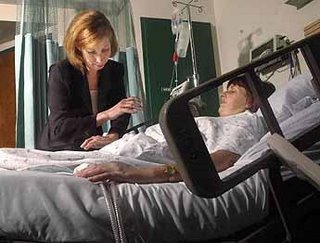 For me, the patient's room is sacred ground, a holy place where God is nearest and felt most clearly. It is where the patient has that little bit of control over what is happening to them. And it is the chaplain's place to ensure that tenuous bit of control no matter how short lived at that time. We ask if we may come in, we ask if we may stay awhile, if we can help in any way to make them more comfortable, we accept them no matter how they or things look. It is when we hold a trembling hand, or one gripped in pain, that we are doing our part. It is where we hear the life story, so the patient can be heard and perhaps reveal or come to terms with a wrong they have done to someone and aren't sure if they are forgiven. We contact anyone they give permission to contact on their behalf, for whatever reason.
We clear the room of assorted visitors so the patient can rest and sleep. We mediate disputes in waiting rooms and hallways, knowing that all of this is ultimately for the patient's benefit. It's not easy and things can get nasty. But they can also be a time of blessing and healing. And it is not unusual for us to comfort the medical staff. Often there is a patient whose life could be prolonged with some independance but the patient refuses treatment. It is the medical worker's goal to help life be sustained, and when circumstances go against everything they were trained to do, it can be difficult for them, as well as clinicians, or social workers.
It is a hard thing we do when trying to broach carefully and considerately the topic of organ donation when all hope of recovery is meted out and you have to talk to parents or children, or a partner that doing so would be the right thing, even when they can't see it, that their loved one would bring life to a stranger...usually a grateful stranger who has been waiting, their life on hold.
Or it is the patient in ICU who may never wake up from a head trauma, the surviving loved companion's life turned inside out by the careless or unanticipated act of another. No life will never be the same for the family of the injured or that of the one who perpetrated the act, intentionally or accidently. And it all happens in seconds.
Fear drives many to do things to ensure their own outcome. Whether it is a husband, wife, partner, parent or child--it doesn't matter. If they fear that their hospitalized loved one may not make it, they can be overcome by the fear of being alone the rest of their lives. So to prevent that from happening they might take their own life as a safety measure because they don't think they can go on without that person. The saddest part is when the patient makes it fine only to learn that the one they knew was waiting for them no longer waits in this life but the next. Not only are they immersed in physical pain but the heartbreak of their being alone now, awash with grief and guilt.
It is times such as these that a chaplain is there in that setting to listen, to hold, to take the verbal abuse meant for the one gone from their midst. And there is no time limit to the visit unless the patient imposes one. It is a ministry of listening for the most part. And after a while we hear the stories of that relationship, the good, the joyful, the sad, and the difficult. It honors the memory of the one no longer with us, it reaffirms our history to that person, and they live on.
We learn to celebrate those lives as well as the joyful occasions. You know, a successful operation, a cured cancer, a newborn child. We serve communion or Eucharist as needed, we baptized as requested using scallop shells for the holy water, and then we write in indelible marker the name of the baptized, the date and place and give it to the parents or the grown children as the case may be to remember and document the occasion. We anoint the sick and dying, we pray over them all and with those who love them. We also are there for non-Christian patients since it is not our mission to convert anyone to a particular faith of belief system. So whether the patient is Native American needing a smudging ceremony or an Indian patient needing an atmosphere in which to meditate, or a Jewish patient needing a rabbi or a kosher meal, we are there to facilitate the spiritual needs of that person, their family and occasionally the staff.
You can end up seeing 10 or 15 patients a day, if not more depending on the census that day. You are on the go, waiting for elevators or taking the stairwells. We, along with all who are the pulse of the medical center, hospital or transitional care unit, move in a synchrony, like red blood cells carrying life giving oxygen to its parts, as white corpuscles, warding off sickness and death, or at least trying to. It's never easy, whether you succeed or fail in your day, you are literally mentally, emotionally and physically exhausted by days end.
Who then cares for the chaplains? Where is their respite? It is in God, Healer, Life-giver, Mother. And where do we find Him? In other chaplains, our ministers and priests, our fellow parishioners, they restore us and renew us so we can do it again the next day.
Often we secret ourselves away in the chapel and weep for all we tried to do that day and give thanks for what we were able to accomplish. Or we sit in our car and wail our grief there, or once we are home, alone or in an unoccupied place or room, we lay face down on the floor and cry out to God, our shoes left at the door. We enter that holy place and give our offerings of pain to Him who suffered for us and understands beyond our own comprehension.
It is not an easy calling but a calling it is. If you think you have a gift for such ministry, consider volunteering at your local hospital. They usually have programs that train you on hospital policies and procedures, as well as time for mentoring and shadowing staff chaplains so you can see how the ministry is "done". Talk to your priest or pastor about pastoral care at your church or synagogue or mosque. Consider the Community of Hope at www.slec.org program for members of your congregation so they can learn to become lay chaplains. Locally both Providence Medford Medical Center and Rogue Valley Medical Center have lay chaplaincy training programs, usually offered once or twice a year for a modest fee to cover materials. You can find out more by visiting these links respectively: http://www.providence.org/medford/services/e40Spiritual.htm and http://www.asante.org/StandardPage.asp?MenuID=1492&TopMenu=2 . At the Asante site it will talk of volunteer opportunities and not pastoral care directly. Use the contact emails at the bottom of the page to obtain further information.
If you have general questions about hospital chaplaincy, just email me and I will try to answer your questions, or at least point you in the right direction.
Until then, be swift to love!
Catherine+
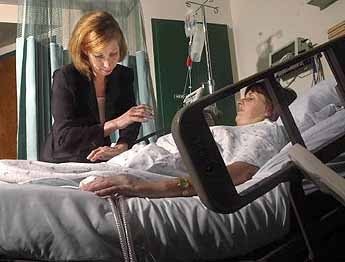 For me, the patient's room is sacred ground, a holy place where God is nearest and felt most clearly. It is where the patient has that little bit of control over what is happening to them. And it is the chaplain's place to ensure that tenuous bit of control no matter how short lived at that time. We ask if we may come in, we ask if we may stay awhile, if we can help in any way to make them more comfortable, we accept them no matter how they or things look. It is when we hold a trembling hand, or one gripped in pain, that we are doing our part. It is where we hear the life story, so the patient can be heard and perhaps reveal or come to terms with a wrong they have done to someone and aren't sure if they are forgiven. We contact anyone they give permission to contact on their behalf, for whatever reason.
We clear the room of assorted visitors so the patient can rest and sleep. We mediate disputes in waiting rooms and hallways, knowing that all of this is ultimately for the patient's benefit. It's not easy and things can get nasty. But they can also be a time of blessing and healing. And it is not unusual for us to comfort the medical staff. Often there is a patient whose life could be prolonged with some independance but the patient refuses treatment. It is the medical worker's goal to help life be sustained, and when circumstances go against everything they were trained to do, it can be difficult for them, as well as clinicians, or social workers.
It is a hard thing we do when trying to broach carefully and considerately the topic of organ donation when all hope of recovery is meted out and you have to talk to parents or children, or a partner that doing so would be the right thing, even when they can't see it, that their loved one would bring life to a stranger...usually a grateful stranger who has been waiting, their life on hold.
Or it is the patient in ICU who may never wake up from a head trauma, the surviving loved companion's life turned inside out by the careless or unanticipated act of another. No life will never be the same for the family of the injured or that of the one who perpetrated the act, intentionally or accidently. And it all happens in seconds.
Fear drives many to do things to ensure their own outcome. Whether it is a husband, wife, partner, parent or child--it doesn't matter. If they fear that their hospitalized loved one may not make it, they can be overcome by the fear of being alone the rest of their lives. So to prevent that from happening they might take their own life as a safety measure because they don't think they can go on without that person. The saddest part is when the patient makes it fine only to learn that the one they knew was waiting for them no longer waits in this life but the next. Not only are they immersed in physical pain but the heartbreak of their being alone now, awash with grief and guilt.
It is times such as these that a chaplain is there in that setting to listen, to hold, to take the verbal abuse meant for the one gone from their midst. And there is no time limit to the visit unless the patient imposes one. It is a ministry of listening for the most part. And after a while we hear the stories of that relationship, the good, the joyful, the sad, and the difficult. It honors the memory of the one no longer with us, it reaffirms our history to that person, and they live on.
We learn to celebrate those lives as well as the joyful occasions. You know, a successful operation, a cured cancer, a newborn child. We serve communion or Eucharist as needed, we baptized as requested using scallop shells for the holy water, and then we write in indelible marker the name of the baptized, the date and place and give it to the parents or the grown children as the case may be to remember and document the occasion. We anoint the sick and dying, we pray over them all and with those who love them. We also are there for non-Christian patients since it is not our mission to convert anyone to a particular faith of belief system. So whether the patient is Native American needing a smudging ceremony or an Indian patient needing an atmosphere in which to meditate, or a Jewish patient needing a rabbi or a kosher meal, we are there to facilitate the spiritual needs of that person, their family and occasionally the staff.
You can end up seeing 10 or 15 patients a day, if not more depending on the census that day. You are on the go, waiting for elevators or taking the stairwells. We, along with all who are the pulse of the medical center, hospital or transitional care unit, move in a synchrony, like red blood cells carrying life giving oxygen to its parts, as white corpuscles, warding off sickness and death, or at least trying to. It's never easy, whether you succeed or fail in your day, you are literally mentally, emotionally and physically exhausted by days end.
Who then cares for the chaplains? Where is their respite? It is in God, Healer, Life-giver, Mother. And where do we find Him? In other chaplains, our ministers and priests, our fellow parishioners, they restore us and renew us so we can do it again the next day.
Often we secret ourselves away in the chapel and weep for all we tried to do that day and give thanks for what we were able to accomplish. Or we sit in our car and wail our grief there, or once we are home, alone or in an unoccupied place or room, we lay face down on the floor and cry out to God, our shoes left at the door. We enter that holy place and give our offerings of pain to Him who suffered for us and understands beyond our own comprehension.
It is not an easy calling but a calling it is. If you think you have a gift for such ministry, consider volunteering at your local hospital. They usually have programs that train you on hospital policies and procedures, as well as time for mentoring and shadowing staff chaplains so you can see how the ministry is "done". Talk to your priest or pastor about pastoral care at your church or synagogue or mosque. Consider the Community of Hope at www.slec.org program for members of your congregation so they can learn to become lay chaplains. Locally both Providence Medford Medical Center and Rogue Valley Medical Center have lay chaplaincy training programs, usually offered once or twice a year for a modest fee to cover materials. You can find out more by visiting these links respectively: http://www.providence.org/medford/services/e40Spiritual.htm and http://www.asante.org/StandardPage.asp?MenuID=1492&TopMenu=2 . At the Asante site it will talk of volunteer opportunities and not pastoral care directly. Use the contact emails at the bottom of the page to obtain further information.
If you have general questions about hospital chaplaincy, just email me and I will try to answer your questions, or at least point you in the right direction.
Until then, be swift to love!
Catherine+
Subscribe to:
Posts (Atom)